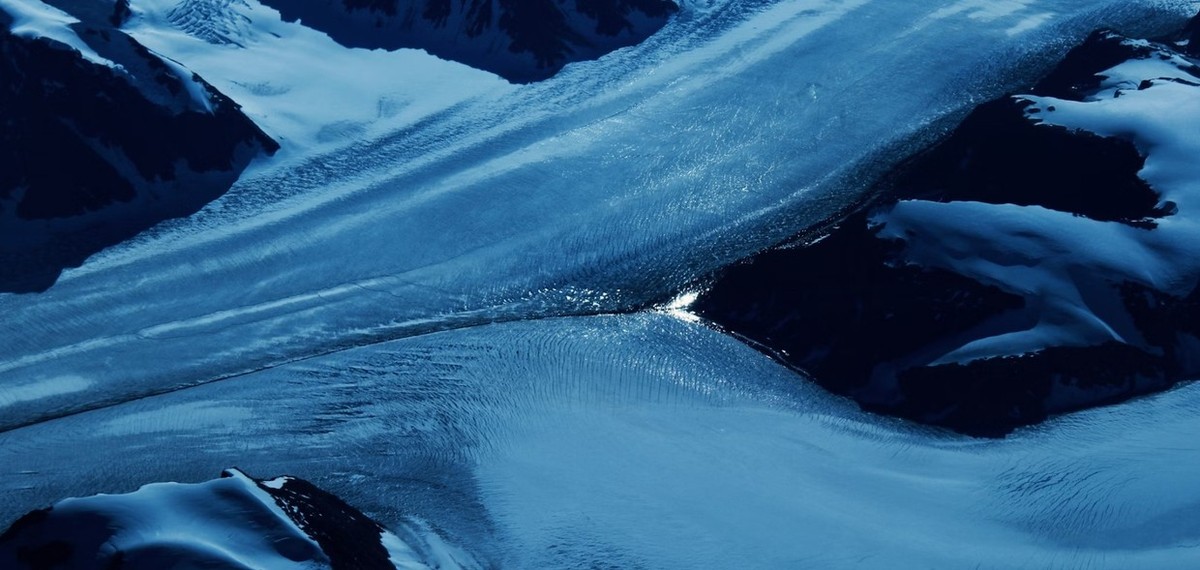
Our 12-day South Greenland: South Greenland: Exploring Glaciers, Fjords and Viking Culture takes you to remote Greenlandic settlements rarely seen by independent travelers. This itinerary delivers some of the wildest landscapes you’ve ever imagined: towering icebergs and sweeping glaciers, plus the chance to see the Greenland Ice Sheet—the second-largest ice mass on the planet. For Viking enthusiasts, South Greenland is one of the best places on Earth to experience Norse history. You can step into Viking ruins that date back to 985.
- Check off two of the world’s most northerly capital cities: Nuuk and Reykjavik
- Visit colorful Greenland villages rarely seen by independent travelers
- Stand in awe before towering icebergs and sweeping glaciers
- Explore Kujataa, a UNESCO World Heritage Site where Viking and Inuit history meet
- Embrace once-in-a-lifetime opportunity to kayak remote Greenlandic fjords
- Experience the most dramatic fjords of South Greenland, including a chance to see the southern outlet of the massive Greenland Ice Sheet.
Availability is always subject to confirmation. Please check with us before booking flights
Prices quoted here are often dependent on currency fluctuations. Please check with (01432 507450 or info@small-cruise-ships.com) for the very latest price, which may well be cheaper than the one advertised here.

Arrive in the Icelandic capital and make your way to the group hotel—included in the Charter Flight & Hotel Package—near Keflavik airport. You will have the rest of the day to explore this fascinating city, known for its Norse history and stunning architecture. If you do plan to visit the city of Reykjavik, make sure you allow for a one-hour transfer (by taxi or public transit) between Keflavik and Reykjavík.
After an early breakfast at the hotel, your group will transfer to the airport and board our private charter flight to Nuuk, Greenland. Upon arrival—and if time allows—you may be transferred from the airport to a central downtown location to enjoy some time on your own to explore this quaint port town before making your way to the pier. After a late afternoon embarkation, you will depart Greenland’s capital city en route to the stunning Arctic wilderness and picturesque coastal communities.
Your first full day in Greenland will be spent onboard Ultramarine as we transit south along the west coast of the largest island in the world. Today is an excellent opportunity to learn about Greenlandic history, glaciology, and ecology from our team of onboard polar experts. Spend some time on the outer deck to spot ice carried along by the currents of Baffin Bay, observe seabirds in flight above and around the ship, and keep your eyes peeled for any Arctic wildlife. Today also includes all mandatory briefings and preparations for Zodiac excursions other off-ship adventures.
Your first day of off-ship excursions will introduce you to the Southwest Greenland region known as Bredefjord (Ikersuaq in Greenlandic), a network of bays, coves, islands and fjords surrounded by mountains. As always, weather and sea conditions determine the day’s activities. We hope to visit Qalerallit Sermia, which features three glacial faces descending from the Greenland Ice Sheet. With glaciers stretching toward the sea, you may also see— and hear—glacial runoff in the form of cascading streams or waterfalls. Set against the crackling of ice, the silence here is paradoxically loud—and hauntingly beautiful. The terrain, like much of Greenland, is uneven without defined trails, but many locations are suitable for hiking. Some guests may opt to charge uphill to gain an elevated perspective, while others choose to walk slowly and appreciate the landscape. Our team accommodates hikers of all levels of ability. We will experience rugged mountain landscapes and striking glacial scenery. Glaciers can be found in many bays and coves, and you will see icebergs of various shapes and sizes drift by. We may explore them more intimately by Zodiac—from a safe distance, of course.
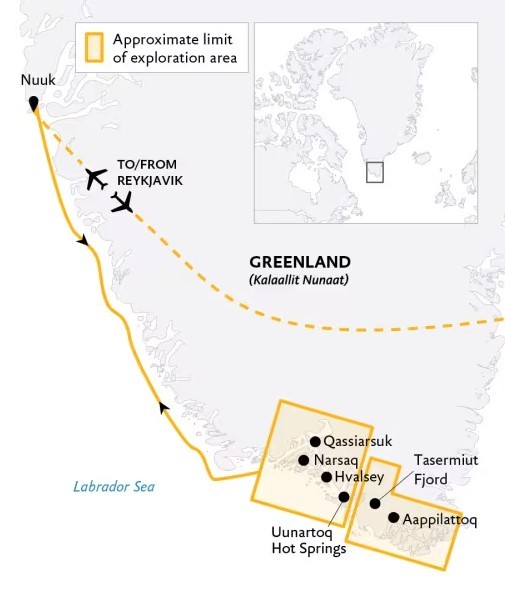
South Greenland is steeped in lore surrounding the famous Greenlandic Viking, Erik the Red, and the seemingly sudden disappearance of Norse settlements. It’s no surprise that many of our guests have come in the hopes of witnessing vestiges of this lost civilization. Today, we’ll get to walk in the footsteps of those long-gone Vikings. We’ll visit Narsaq, on Tunulliarfik Fjord, where you’ll immediately notice the brightly colored homes that have been occupied for generations. Ranging from reds and greens to blues and yellows, many trimmed in bright white, the community stands out as particularly picturesque. Guided walks in and around Narsaq will include some of the oldest Norse settlement ruins in Greenland— adjacent to an active community of locals going about their day-to-day lives. We also hope to visit Qassiarsuk, home to Brattahlíð, the site of Erik the Red’s original estate. Located in a surprisingly verdant part of South Greenland, the landscape is lush with vegetation and dotted with grazing sheep. It’s this fertile setting that drew Norse settlers here more than a thousand years ago, and today, the area offers a vivid picture of that distant past. Carefully restored with reconstructions of original Norse buildings, the site invites visitors to imagine daily life in this historic settlement. A small community of Greenlandic residents still lives in a place where ancient Norse traditions and modern Greenlandic culture thrive side by side.
The deep fjord of Tasermiut is striking in its stark natural beauty. Steep mountains rise abruptly from the sea. Sharp peaks and ridgelines dominate the skyline, while the valley floors and lower slopes support a surprisingly diverse mix of vegetation—grasses, wildflowers, lichens and hardy dwarf trees. Signs of glacial retreat are clearly visible: once ice-filled valleys now channel milky blue rivers that fan out into small deltas and tidal f lats as they meet the fjord. The intention here is to explore by foot, with hiking routes suitable for guests with a range of interests and abilities. Some may choose a faster-paced trek to reach deeper into the wilderness, while others may take their time, pausing to admire the incredible landscape. As in previous outings, the ground will be uneven— rocky in places, with patches of moss and low vegetation. Our route will depend on conditions, but possible destinations include Klosterdalen and Qoorormiut Kangilliit—both known for their dramatic mountain backdrops.
The epic scenery continues as we make our way toward Prins Christian Sund, which is synonymous with dynamic ice conditions. This narrow body of water is wedged between steep mountain ranges to the north and south, and it can serve as a corridor for both glacial and sea ice. Intimacy and grandeur apply here, as the narrowest section of the body of water is roughly 400 meters (1,300 feet) across. High above, on both sides of the fjord, are mountain summits that reach between 1,300 (4,200 feet) and 1,700 meters (5,500 feet) above sea level. In other words, these mountains can—and do—rise nearly vertically. We may explore the glacial ice by ship and Zodiac. During the summer glacial runoff, and particularly after rains, this region is home to numerous waterfalls, cascading down seemingly vertical mountain sides. To feel the true scale of nature, you need only sail through Prins Christian Sund. If conditions allow, we may also visit the small village of Aappilattoq, home to fewer than 100 residents. Similar to other coastal Greenlandic communities, this small village is known for colorfully painted homes against a backdrop of cliffs and mountains—and icebergs, which regularly drift by the small community, and are often seen inside the inner harbor. There’s something almost mythical about Aappilattoq, where the inhabitants, many of them fishermen, live alongside drifting icebergs and powerful mountain ranges.
In summer, the valleys and foothills of Uunartoq Fjord live up to the name Greenland. A region of mountains and stunning geology, Uunartoq also offers a diverse range of plant life. Pockets of grasses, mosses, lichens, and flowering plants, including delicate orchids, grow here, adding splashes of color to this otherwise mountainous, glacial landscape. The hiking routes are stunning, particularly for those fascinated by how plants and wildlife adapt to life in the Arctic and sub-Arctic. You can choose from hikes of varying difficulty—from longer treks with gentle elevation gains to slower, more contemplative walks that allow you to stop and smell the flowers. The adjacent waters are home to icebergs and marine mammals. Shifting shades of white and glacial blue ice drift with the currents, scattering uniquely shaped ice forms across the landscape. You may spot marine mammals, such as seals and various species of whales. Minke and humpback whales are the most common in Uunartoq Fjord, though we occasionally see fin whales, as well. Uunartoq Fjord is also known for its geothermal hot springs, and depending on conditions, it may be possible to visit some of these natural hot springs during our visit.
The four walls and foundation of the stillstanding 14th-century Hvalsey church are considered the most iconic of all Norse ruins in Greenland. For history buffs, this site is akin to a pilgrimage. While we will have encountered Norse ruins earlier in the voyage and visited reconstructions of long-lost villages, Hvalsey evokes a surprisingly complex range of emotions— haunting, reverent, and deeply curious. Standing almost alone in an otherwise wild landscape, the Hvalsey church prompts one to wonder how civilizations can be forgotten for centuries, and then suddenly remembered. The rolling terrain of this well-chosen site, a mix of rock and vegetation, will appeal to hikers in the group.
While heading to Nuuk, relax and enjoy yourself as we cruise along the coast of Greenland, or continue your Arctic education by attending another expert-led presentation. Weather-permitting, there may be an opportunity for one last shore excursion near Ivittuut, a small peninsula on the mainland. Today is also your last chance to take advantage of Ultramarine’s beautifully-designed Tundra Spa & Sauna.
After breakfast, guests will be transferred from the pier to the town center. You will have a half-day to explore Old Nuuk and visit the Hans Egede Church and waterfront statue, commemorating the Norwegian missionary who founded Greenland’s first European settlement in 1721. Guests will also have a chance to visit the Greenland National Museum to explore exhibits on Greenland’s cultural heritage, including the famous 500-yearold mummies and the 4,000-year-old kayak tradition. After exploring Nuuk, guests will meet at a designated spot in town for the transfer to the airport for their charter flight to Reykjavik, which is included in the Charter Flight & Hotel Package.
After breakfast at your included hotel, make your way independently to Keflavik international for your onward f light, or continue your independent explorations of Reykjavik at your leisure.
Itineraries are subject to change.
Ultramarine
| Length: | 128m |
|---|---|
| Passenger capacity | 199 |
| Launched | 2020 |
Ultramarine is designed to go beyond the familiar in polar exploration, to discover new places, and to immerse you in the best the region has to offer.
Equipped with two twin-engine helicopters, Ultramarine offers the most robust portfolio of adventure activities in the industry, the most spacious suites in its category, breathtaking public spaces, and more outdoor wildlife viewing spaces than other expedition ships its size. It also features an innovative mix of sustainability features that exceed all industry standards.
With all this and more, Ultramarine is set to deliver the ultimate polar expedition experience.
Cabin - Spacious Entryways, Personal Safes, Spa-inspired Bathrooms, Heated Bathroom Floors, Premium beds and bed linens, Convertible Beds, Individual Temperature Controls, HD Flatscreen Televisions, Oversized Windows With Sweeping Views, Electrical Supply: 220V
Aboard - 2 Dining Areas, 4 Bars, Panorama Lounge, Lecture Theater, Library, Polar Boutique, Spa & Fitness Center, Oceanview Sauna, Zodiac Hangar with 4 Embarkation Points, 2 Ready Rooms with Individual Lockers, Walkaround Deck, Bridge
Activities - Flightseeing (Included), Zodiac Cruising (Included), Hiking (Included), Lectures (Included), Camping (Optional), Sea Kayaking (Optional), Stand-Up Paddleboarding (Optional), Paddle Excursions (Optional), Cross Country Skiing (Optional), Mountaineering (Optional)
Deck plans are for illustrative purposes only – The actual ship and cabin layout may differ.